The 48 Blood Groups You’ve Never Heard Of
Jon Lee Andrade, Ph.D.
February 2026
(6 minutes)
All of us identify with one or more categories that say something definitive about who we are as people. You could probably rattle off a bunch right now–your astrological or Chinese zodiac sign, your birthstone, maybe your Myers-Briggs or Big Five personality type, more than likely your Hogwarts house or ATLA bending style. So, it’s a bit strange that most of us have no idea what our blood type is, a category with far more serious consequences to not know you’re a part of.
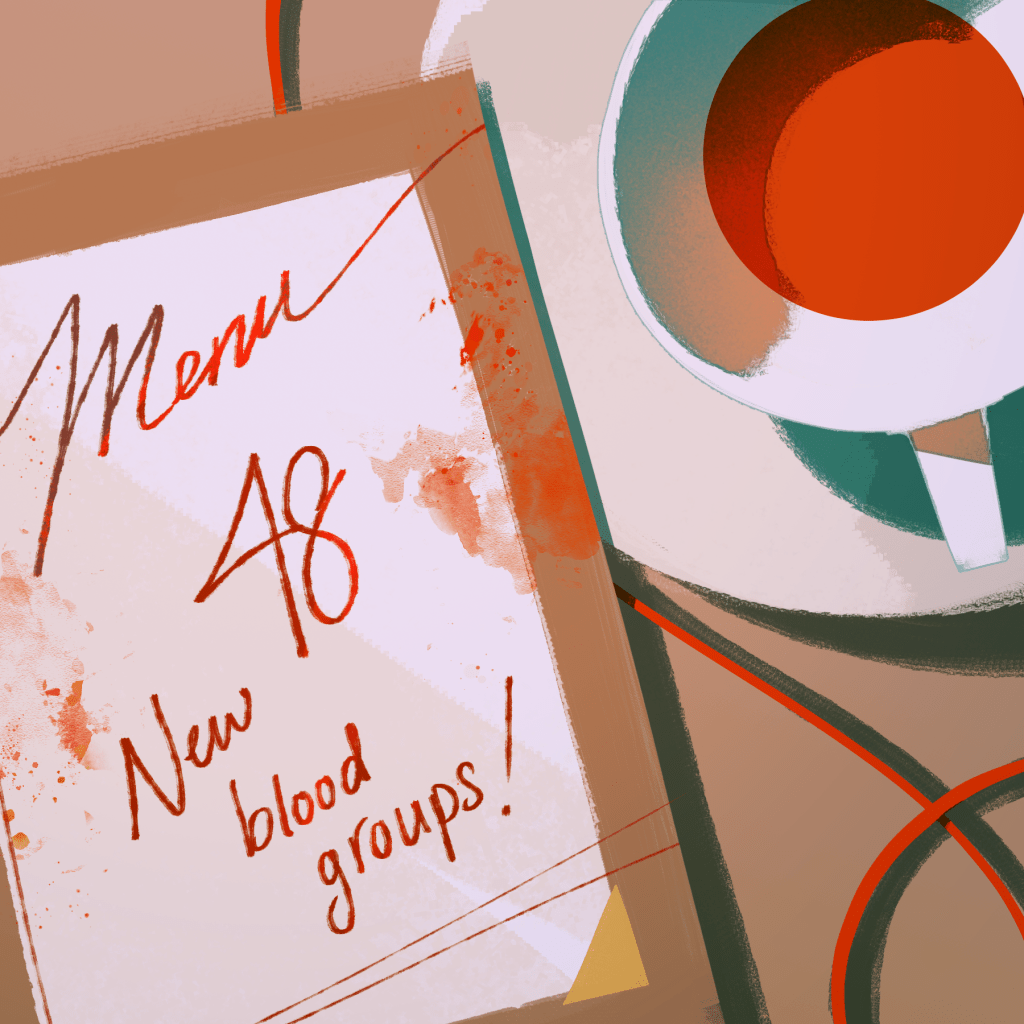
Here’s the rub though. Even if you do know your blood type, chances are you only know your type for two blood groups. These are the ABO blood group that gives you–naturally–A,B, or O type blood, and the Rh blood group that gives you positive or negative type blood. Turns out, however, that there are currently 48 different blood groups–too complex even for a BuzzFeed quiz.
Without getting too in depth–although I’m sure you wouldn’t mind considering you’re reading about blood types for fun–your blood is made up of two major constituents. You have your red blood cells, which are responsible for moving oxygen around your body, and you have your plasma, the liquid component of your blood, which is mostly (92%) water but also hormones, vitamins, and nutrients that need to travel across your body.
Where blood type factors into this is in the fact that on your red blood cells there are little surface markers–called antigens–made of sugars and proteins that your immune system can use to identify them. And in your plasma, you have antibodies–protein sensors that bind to these markers–against the blood antigens you don’t have but not against the antigens you do have. Normally, antibodies are made in response to exposure to a foreign antigen, so why do we have antibodies for blood we don’t have? Well, we aren’t really sure, but if you’d like to do some deeper reading, there’s a recent review article on the subject that goes into some of the leading ideas, including the hypothesis that blood-related antibodies are made through exposure to our gut microbiome.
The important part here is that if you’re missing an antigen–and therefore make antibodies against it–your body will react pretty darn poorly to having that antigen suddenly introduced, which can happen if you need to get a blood transfusion. Your immune system will go into hyperdrive, attack all the new blood in a process called hemolysis, and could leave you dead very quickly. This is why a person with AB blood can receive A or B blood, but a person with O blood (i.e. without A or B) can’t receive either. In fact, a person with O-negative blood–without any of the ABO or Rh antigens–is called the “universal donor” because their blood won’t cause reactions in people with any of the other 7 blood types. But it’s actually a bit more complicated than that.
As of 2025, 124 years after the discovery of the ABO group by Karl Landsteiner, we know of 48 different blood groups, each with their own sets of antigens that combine into a dizzying number of blood types. And when medical professionals are finding blood donors for their patients, they need to consider all 48. This is critical for people with rare negative blood types who don’t carry a common antigen and so can’t receive blood from most people on the planet. Some of these blood types are so incredibly rare that less than 50 people are known to have it across the entire planet, requiring these individuals to freeze samples of their own blood in case of an emergency or planned surgery.
For example, the Bombay blood group was discovered in today’s Mumbai and recognized as the 18th group in 1952. Individuals with the Bombay phenotype lack what’s called the H antigen, with the occurrence for this phenotype at about 1 in 250,000 worldwide, reaching around 1 in 10,000 in Mumbai. An interesting fact about the H antigen is that it’s the precursor to the A and B antigens, so individuals with the Bombay phenotype are missing these antigens as well and so can’t receive A and B blood but also O blood, the “universal donor,” because O-type individuals still have the H antigen.
In 1961, an extremely rare blood type known as Rhnull was discovered. Remember when I said the positive and negative blood types were controlled by the Rh antigen? Well, that’s just one Rh antigen, RhD. There are actually 61 different antigens in the Rh blood group, and Rhnull individuals are negative for every single one. Rhnull is the second rarest blood type–recently dethroned by our newest blood type below–with less than 50 individuals worldwide possessing it. Because of this rarity, and because of the immense value Rhnull negative blood has for donations, it is also commonly called “golden blood.”
Jumping forward a bit, the MAL blood group was officially recognized as the 47th blood group in 2024, following a 50-year-long investigation of a blood sample taken from 1972. The antigen for this group is AnWj, which was found to be a modification on top of a protein called MAL. Around 1 in 180,000 individuals are AnWj-negative, so not as rare as golden blood. It is interesting though that 3 AnWj-negative individuals were found without any mutations in the gene encoding MAL, and newborns actually don’t have any AnWj antigens until at least a few days after birth, suggest there could be reasons outside of genetic code that can lead to this rare blood type.
The newest and rarest blood group, PIGZ, was recognized as the 48th in May of 2025. It was actually discovered as a routine blood test in preparation for surgery. In 2011, a woman from Guadeloupe–living in Paris at the time–learned that her blood plasma reacts with the blood of every single donor the doctors could find, even her own relatives. Since then, we’ve learned that it’s because of a missing antigen synthesized by the enzyme, PIGZ, leaving this individual as literally the only person in the world with this blood type, which has been named Gwada-negative, referencing a local nickname for Guadeloupe. It’s here where researchers intend to search for more individuals with this blood type.
It’s all very interesting stuff, and we haven’t even started talking about stranger phenomena like hybrid blood types, where an antigen could become an intermediate between two others and activate both kinds of related antibodies. It’s also really important to note that understanding how blood systems work has huge potential benefits for human health. Quirks of biology like this have serious impacts on people in need of medical intervention, so the more we understand, the better equipped we are to help those people–including those who are, quite literally, one of a kind.
 Grads Gone Rogue
Leave a comment