Here’s where to learn the basics.
Abby Duimering, B.S.
March 2026
(5 Minutes)
Have you ever watched the movie, The Martian, based on Andy Weir’s novel with the same name? If so, I’m sure you remember the highs and lows of Matt Damon’s character, Mark Watney, in growing and maintaining the potato garden that sustained him while he was stranded on planet Mars. While Watney inevitably was able to produce potatoes despite the minimal resources he had, had he been aware of the research station, “Biosphere 2”, he could have arrived even more prepared for the challenges of being isolated on Mars.
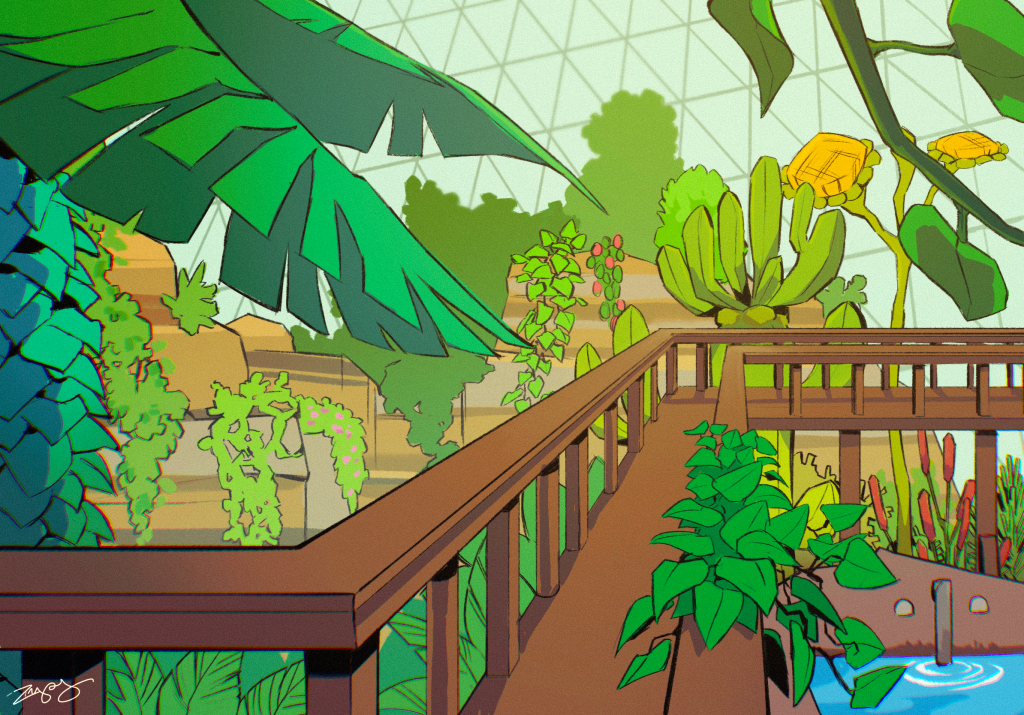
Biosphere 2 is an American Earth System science research facility in Arizona. Its name comes from the notion that if Earth is Biosphere 1, then this experimentally manipulated station is a second new and unique biosphere. Inside the glass and steel enclosed station, there are multiple miniature ecosystems including an ocean with coral reefs, mangroves, tropical rainforest, and analogs for the Moon and Mars amongst many other ecosystems.
Interestingly, the station was originally created in the 1980s to research and develop self-sustaining space-colonization technology, global ecology, and many other biologically inclined goals. After its construction, there were two “space” missions conducted: one in 1991 and another in 1994. From September 26th 1991 to the same day in 1993, 8 people, titled “Biospherians”, lived inside Biosphere 2 physically isolated from the outside world. The crew included: Roy Walford, Jane Poynter, Taber MacCallum, Mark Nelson, Sally Silverstone, Abigail Alling, Mark Van Thillo, and Linda Leigh. A primary goal of the mission was to study humans engaged in work during a long-term isolation mission to inform future space-applications of a manned mission to Mars.
Life on Biosphere 2
The Biospherians had private living quarters, access to communication with the outside world through multiple forms of media, as well as a gym, and a library. Crew members were specifically chosen for their extensive knowledge of the facility’s various systems, which proved crucial for mission success. Asdocumented in a 2002 study by Alling and colleagues, crew involvement in the design and construction of life support systems proved essential, as it gave them the knowledge needed to troubleshoot problems and fostered a sense that Biosphere 2 was truly their home rather than merely a workplace.
Because the Biospherians knew they were going to be stranded on “Mars” for two years, they planned to grow far more than just potatoes like Watney in The Martian. During the mission, they maintained 86 plant species in the agricultural system within Biosphere 2. The crops included: rice, sweet potato, beets, banana, and papaya. These crops accounted for 81% of their diet and the rest came from the limited portion of meat, eggs, and dairy coming from the system’s domesticated goats, pigs, and chickens.
Despite the agricultural success within Biosphere 2, crew members lost about 10 – 20% of their starting body weight during the first 6 months of the mission. The crew even grew coffee and tea, which they deemed, “necessary for conversation enhancement”, during the mission. A unique consideration planned to sustain both crew harmony and individual well-being.
Throughout the mission, the Biospherians made careful observations to document findings that would be beneficial for a future crewed mission to Mars. Their insights, published years later in the journal Life Support & Biosphere Science, highlighted several critical lessons. First, crew members should help construct their habitats to maximize system knowledge. Second, individuals in closed systems should expect time to physiologically and psychologically adapt to their new environment. Third, success depends on creating a cohesive and satisfying lifestyle, with access to varied crops for good cuisine, outlets for art and music, and crucial down-time from task-driven work. The mission’s success suggested that crews with high cultural diversity, strong commitment, and self-motivated responsibility would increase both mission success and personal satisfaction.
Biosphere 2 Today
The station is still up and running active research experiments, however, they are less space oriented. The variety of functional ecosystems maintained there now are used in biology, chemistry, and climate research to better understand how systems will respond to anthropogenic climate induced changes.
In a 2021 study published in Science, researchers examined the effects of 4-month long drought on the enclosed tropical rainforest. Using isotopically “heavy” elements that act like a tracer dye in environmental systems, researchers traced the movement of water and carbon through drought tolerant and sensitive plants. The tropical rainforest plants responded differently under the drought.
Canopy trees were resilient despite the conditions, sparing their water reserves until late into the drought. However, the capacity to act as a carbon sink, or a place to hold CO2 instead of the atmosphere which could accelerate climate warming, sharply declined. The complex responses of tropical rainforests to extreme environmental conditions will continue to be studied in research stations like Biosphere 2 to better predict ecosystem responses to climate change.
While not quite the same, as we continue to experience the effects of human-induced rapid climate change, we are in a way embarking on a mission as a global community into uncharted territory of an unknown climate and living conditions. Hopefully, we can incorporate the positive observations of the Biospherians into life on Biosphere 1: the importance of diverse teams working together, the value of understanding the systems we depend on, and the recognition that both technical knowledge and human well-being are essential for mission success.
 Grads Gone Rogue
Leave a comment