A real-life Jurassic Park story unfolding in the Galápagos
Christen Snyder, B.S.
April 2026
(6 Minutes)
For decades, the idea of bringing extinct species back to life has mostly belonged to science fiction. Jurassic Park imagines dinosaurs resurrected from fragments of ancient DNA, an ambitious experiment that, unsurprisingly, goes horribly wrong. But in the Galápagos, scientists are accomplishing something that feels surprisingly similar, yet grounded in real-world conservation and long-term ecological restoration.
Giant tortoises once disappeared from Floreana Island nearly two centuries ago. Now, conservationists have begun returning them to the landscape where they once roamed. No amber-encased DNA or dinosaurs were required. Instead, the effort emerged from decades of conservation work and an unexpected genetic discovery that connected tortoise populations across different islands in the archipelago (Garrick et al., 2012).
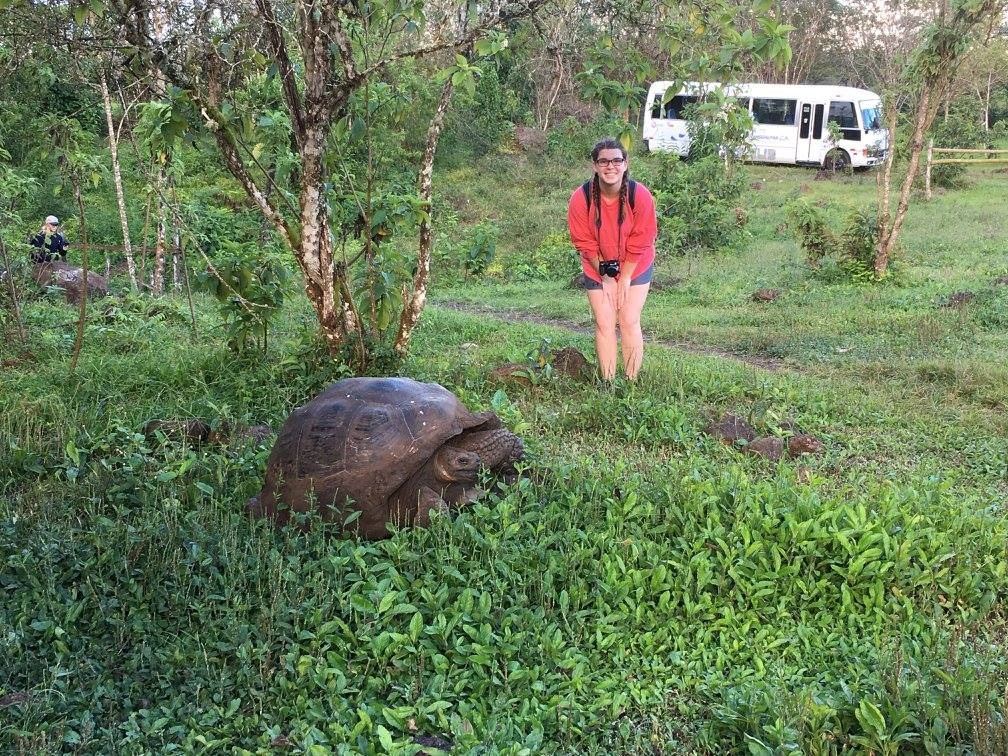
I first encountered this conservation effort in 2018, when I visited the Galápagos as part of a course on the ecosystems of Ecuador and the islands. One of our stops was the Charles Darwin Research Station where we walked through the tortoise breeding center. Each enclosure housed tortoises from a different island lineage, reflecting the remarkable evolutionary diversity of these animals across the archipelago. Later in the trip, we saw the other side of that story at El Chato Tortoise Reserve on Santa Cruz Island, where giant tortoises roam freely through the highland forests.
We also visited Floreana Island during that trip. The island was quiet and sparsely populated, with volcanic landscapes, black sand beaches, and dense vegetation in the highlands. Standing there, it was difficult to imagine that thousands of giant tortoises once moved across that same terrain. At the time, the breeding programs felt abstract, like an investment in a future too far away to see. Nearly a decade later, that future is beginning to take shape on the island.
The Disappearance of Floreana’s Tortoises
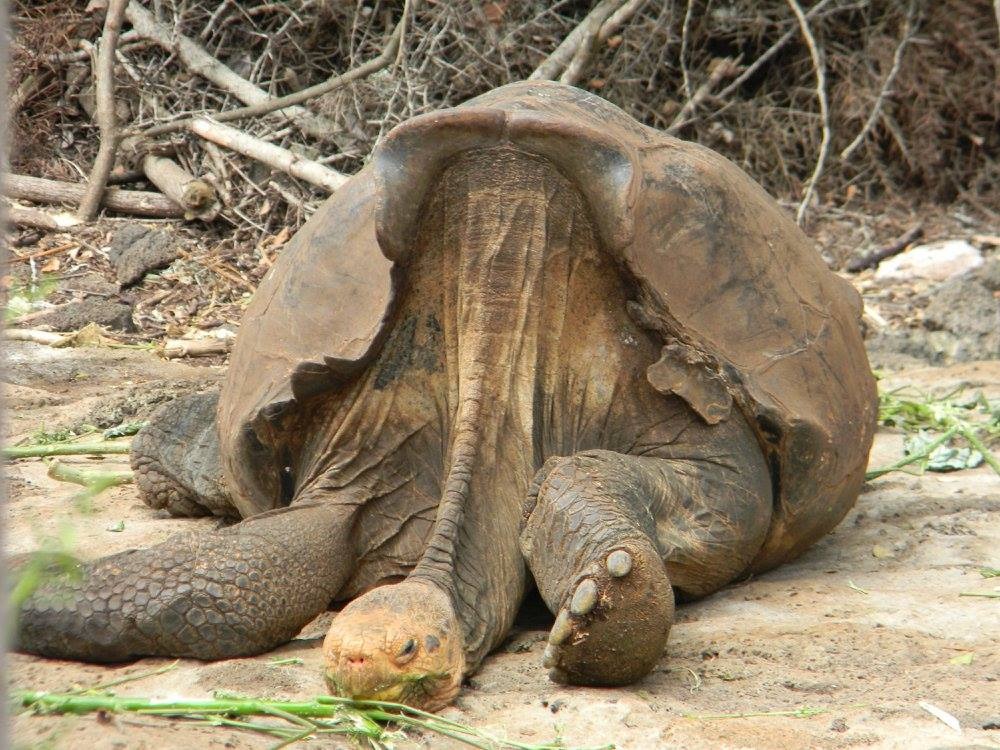
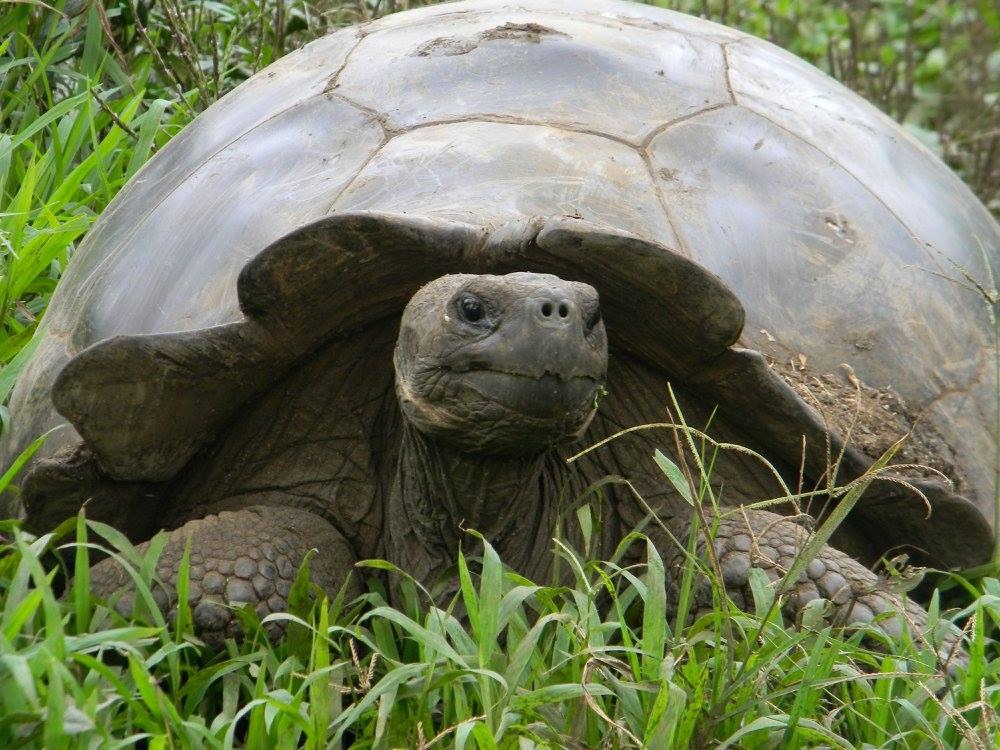
One of the most remarkable aspects of Galápagos tortoises is that they are not all the same. Over thousands of years, tortoise populations became isolated on different islands, allowing them to evolve distinct genetic lineages and physical traits shaped by their environments (Caccone et al., 2002). Some species developed dome shaped shells suited to islands with abundant low vegetation, where they can graze close to the ground. Others evolved the iconic saddleback shell, which has a raised opening at the front that allows the tortoise to stretch its neck upward to reach taller plants and cactus.
Floreana Island once supported its own tortoise lineage and may have been home to tens of thousands of animals before humans arrived in the Galápagos. That population collapsed rapidly after sailors and whalers began visiting the islands in the late 1700s. Giant tortoises were an ideal food source for long voyages because they could survive for months without food or water when kept aboard ships. Sailors also introduced invasive species such as goats, rats, and pigs which damaged vegetation and preyed on tortoise eggs and hatchlings, further accelerating the population’s decline (Conrad et al., 2022). By the mid 1800s, the Floreana giant tortoise was believed to be extinct.
Rediscovering a Lost Lineage
For decades, scientists believed the Floreana tortoise lineage had disappeared completely. That assumption changed in 2008, when researchers studying tortoises on Isabela Island made a surprising discovery. On the slopes of Wolf Volcano, they found tortoises that carried genetic ancestry from the extinct Floreana population (Garrick et al., 2012).
The explanation likely dates back to the same whaling era that drove the species to extinction. Sailors often transported tortoises between islands or kept them aboard ships as food. Some animals were later released or escaped on other islands, and over generations their descendants survived in mixed populations.
Although the original Floreana tortoise population had vanished from Floreana, fragments of its genetic lineage persisted elsewhere. This discovery transformed what once seemed like a closed chapter into a new conservation opportunity. By identifying tortoises with strong Floreana ancestry, researchers uncovered a path to rebuilding the original lineage, leading to a selective breeding program led by the Gálapagos National Park Directorate and the Charles Darwin Research Station. Young tortoises are raised in captivity until they are large enough to survive predators, then gradually reintroduced into the wild. After more than a decade of preparation, tortoises are finally being returned to Floreana.
The Return to Floreana
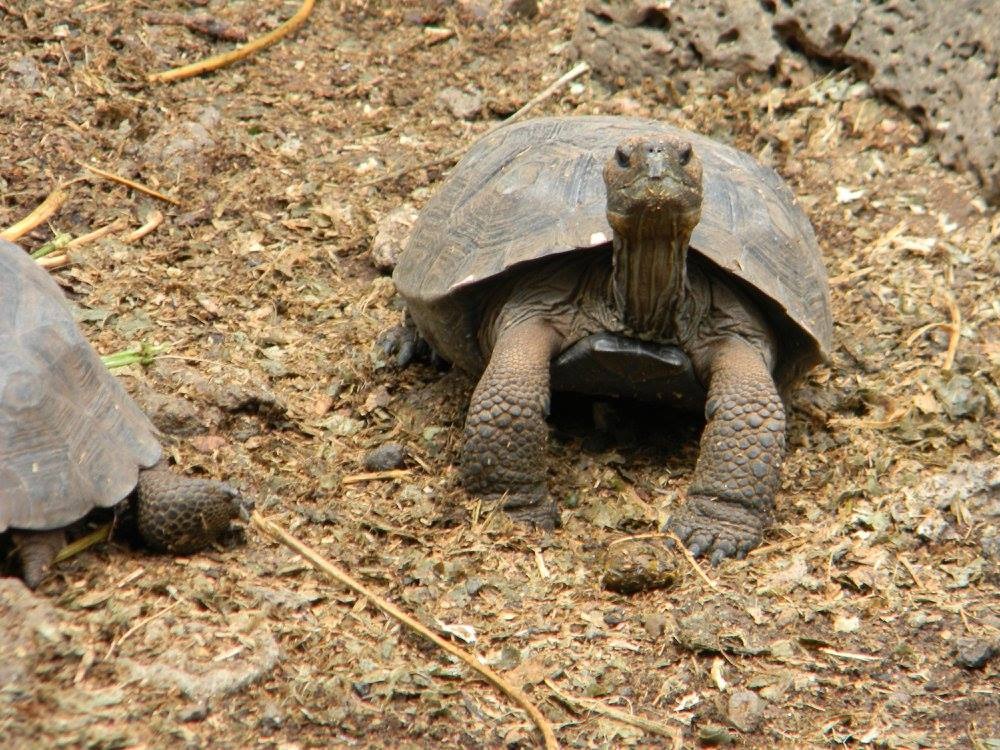
In early 2026, conservationists released more than 150 young tortoises onto Floreana Island, with hundreds more expected in coming years. The goal is not only to restore a species, but to reestablish the ecological processes that once shaped the island. As they move across the landscape, giant tortoises disperse seeds, influence which plants thrive, and open pathways through dense vegetation. Over time, these small, consistent interactions can reshape entire ecosystems (Blake et al., 2012).
If the reintroduction succeeds, Floreana’s landscape may begin to recover in ways that have not been seen for generations. This will not be a rapid transformation. Giant tortoises grow slowly and can live for more than a century, meaning this restoration will unfold over decades. But that timescale reflects something deeper: a commitment not just to preserving ecosystems, but to rebuilding them.
Looking Forward
Unlike the dramatic experiments imagined in Jurassic Park, this story is unfolding slowly, through careful conservation and patience. And for the first time in nearly two centuries, Floreana Island is no longer defined by what it lost, but by what is returning. And hopefully, someday, I’ll get to see tortoises roaming Floreana myself.
References
Blake, S., Wikelski, M., Cabrera, F., Guezou, A., Silva, M., Sadeghayobi, E., Yackulic, C.B. and Jaramillo, P. (2012), Seed dispersal by Galápagos tortoises. Journal of Biogeography, 39: 1961-1972. https://doi.org/10.1111/j.1365-2699.2011.02672.x
Caccone A, Gentile G, Gibbs JP, Frirts TH, Snell HL, Betts J, Powell JR. Phylogeography and history of giant Galápagos tortoises. Evolution. 2002 Oct;56(10):2052-66. doi: 10.1111/j.0014-3820.2002.tb00131.x. PMID: 12449492.
Conrad C, Barceló LP, Scheinberg L, Campbell PD, Wynn A, Gibbs JP, Aguilera WT, Cayot L, Bruner K, Pastron AG, Jones EL. Galápagos tortoise stable isotope ecology and the 1850s Floreana Island Chelonoidis niger niger extinction. Sci Rep. 2022 Dec 23;12(1):22187. doi: 10.1038/s41598-022-26631-y. PMID: 36564467; PMCID: PMC9789057.
Garrick, R. C., Benavides, E., Russello, M. A., Gibbs, J. P., Poulakakis, N., Dion, K. B., Hyseni, C., Kajdacsi, B., Márquez, L., Bahan, S., Ciofi, C., Tapia, W., & Caccone, A. (2012). Genetic rediscovery of an ‘extinct’ Galápagos giant tortoise species. Current Biology, 22(1), R10–R11. https://doi.org/10.1016/j.cub.2011.12.004
 Grads Gone Rogue
Leave a comment