NEO, BCIs, and Neurorehabilitation
Lin Yang, B.S.
May 2026
(5 Minutes)
Neuroscientists have discovered a much greater capacity for neuroplasticity than what traditional wisdom suggested. Whether in the capacity for learning new information or recovering from injuries to existing pathways, our minds are proving that neurodevelopment is not an age-limited phenomenon, but rather a lifelong one.
In the past couple of decades, we have found new ways to enhance this process by integrating in computers to create technology known as brain computer interface (BCI). You may have heard of Neurable’s EEG-based headphones to “boost your productivity”, Blackrock’s brain-controlled computer experiments, or perhaps most famous of all, Nuralink. Technology that seemed like a distant transhumanist cyberpunk future a decade prior is now being used in a wide variety of fields, ranging from prosthetics to entertainment to further-reaching applications in cognitive enhancement. Nothing demonstrates this more aptly than Neuracle Medical Technology’s NEO, the first brainchip-type BCI in the world to be approved for use outside of clinical trials.
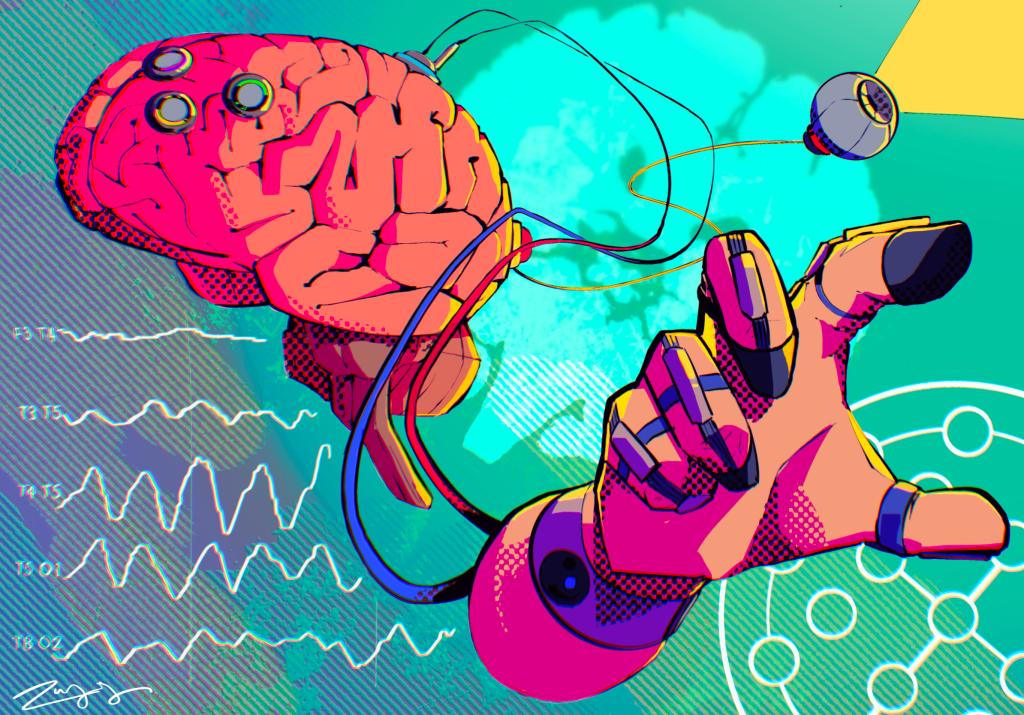
Developed out of Tsinghua University in Shanghai, the NEO BCI is primarily made up of two electrodes. One attaches to the dura mater of the brain as a wireless device, transmitting signals to a second electrode on the outside of the body. Ultimately, the device controls a soft prosthetic exoskeleton glove, enabling hand movement for paralyzed individuals and helping retrain this ability via the strengthening of neural pathways for movement. Due to the epidural location of the electrode, it’s considered to be minimally invasive and at less of a risk for triggering an immune response or damaging nervous tissue.
After a nine-month training period with the device, researchers were able to observe strengthened somatosensory-evoked potentials measured in the arm of the subject as well as increased activity in the somatosensory and motor cortexes (Brodmann areas 1 and 4).
Check out these videos!
[NEO in action]
[NEO results]
Not only is this a landmark event in BCI development, but it once again reiterates the enormous regenerative and plastic potential of our nervous system, especially with the aid of technology. While motor rehabilitation via epidural electrical stimulation (EES) or functional electrical stimulation (FES) are established forms of therapy for severe motor function loss, BCIs present a method of rehabilitation for cases where the damage to the nerves are too extensive, where there are implants preventing the use of electricity, or when the patient does not respond well to electrical stimulation. Instead of introducing outside stimulation via electricity, this system takes advantage of our innate abilities to adapt and heal by simply encouraging the process to occur.
Additionally, the clinical success of this trial will potentially clear the way for further innovation on exoskeleton-based devices and even endoskeletal ones. One notable project in this regard is a collaboration between the University of Chicago, Northwestern University, the University of Pittsburgh, Case Western Reserve University and Blackrock Neurotech. Using electrodes implanted on the somatosensory cortex (Brodmann 1), the research team seeks to simulate touch reception in prosthetics. Sensory feedback is key to much of our fine motor capabilities, and further development of this technology could greatly improve the ability of prosthetics to grasp objects, traverse different terrains, and do many other everyday tasks.
Outside of prosthetic devices, BCI has also emerged in prominence as a treatment for phantom limb pain. Traditionally, treatment is done by providing the patient with a simulated “limb” via a mirror or AR/VR simulation. However, simulations controlled by non-invasive BCI such as EEG tend to be more responsive to the patient and therefore be more effective in this therapy. Recent research has found promise in using BCI and neuroimaging to directly affect cortical reorganization, skipping the need for a simulated “limb” entirely. This route of treatment could be significantly less involved for the patient, and more integratable into everyday life than current setups. Studies have also shown the advantage BCI technology provides in customizing and targeting treatments based on neurofeedback, particularly when combined with VR. In addition to applications in sensorimotor rehabilitation, this type of therapy has also seen use in the treatment of PTSD and various phobias, as treatment can be individualized on the spot by the fear and anxiety signals detected in response to a stimulus.
While it’ll be a bit before we can fully realize all our wildest cyborg dreams, the predecessors of that technology are well within sight. As we learn more about our nervous system’s ability to regenerate, we also unlock new possibilities of what computers and robotics can do to take advantage of that ability. NEO is another exciting step in venturing into the possibilities, but far from the last.
Bibliography
- China approves brain chip to treat paralysis — a world first NEO
- Reclaiming Hand Functions after Complete Spinal Cord Injury with Epidural Brain-Computer Interface | medRxiv NEO
- Minimally Invasive Brain Computer Interface helps tetraplegia restore hand functions-Tsinghua University
- Brain Computer Interface Treatment for Motor Rehabilitation of Upper Extremity of Stroke Patients—A Feasibility Study – PMC – motor rehab therapy
- BCI training to move a virtual hand reduces phantom limb pain: A randomized crossover trial – PMC – BCI phantom limb therapy
- Electrical stimulation for the treatment of spinal cord injuries: A review of the cellular and molecular mechanisms that drive functional improvements – PMC
- Functional Electrical Stimulation (FES): What It Is & Uses
- EEG-Based Brain–Computer Interface with Immersive Virtual Reality for Phantom Limb Pain: A Single-Center Pilot Neurofeedback Trial
- Rewiring Pain: Brain-Computer Interface and Mixed Virtual Reality Approaches to Addressing Phantom Limb Pain – Proceedings of the Texas A&M Medical Student Grand Rounds
- Is Phantom Limb Awareness Necessary for the Treatment of Phantom Limb Pain? – PMC
 Grads Gone Rogue
Leave a comment