why we use other species to study ourselves
Mary Cundiff, Ph.D.
June 2026
(8 Minutes)
The use of model organisms in research raises important ethical considerations. This article does not seek to dismiss those discussions, but instead focuses specifically on the biological and scientific insights that model systems have contributed to research.
Most of what we understand today about heredity, development, physiology, and the cellular and molecular foundations of life comes from research using model organisms. These systems have allowed scientists to study biological processes in controlled and reproducible ways that would otherwise be impossible. But what exactly is a model organism, and why are certain species repeatedly chosen for scientific research?
A Short History of Model Organisms
The use of model organisms in modern science can be traced back to the mid-1800s with the work of Gregor Mendel and his famous experiments on pea plants. At the time, Charles Darwin had proposed theories of inheritance through observational studies, but the underlying mechanisms remained unclear. Mendel sought a more systematic and measurable approach to understanding heredity.
Through carefully controlled cross-breeding experiments, Mendel discovered that traits are inherited according to predictable patterns; principles that would later become the foundation of modern genetics. Many people are first introduced to these concepts through Punnett squares in biology classes, which visually represent Mendelian inheritance.
Mendel’s work also laid the groundwork for selective breeding strategies that would later be applied to some of the earliest laboratory model organisms, including guinea pigs, mice, fruit flies (Drosophila melanogaster), and even viruses. Although genetics research slowed briefly after Mendel’s discoveries, the field exploded in the early 1900s as scientists began uncovering the physical basis of inheritance.
~
The next major wave of genetic discoveries is closely associated with Thomas Hunt Morgan and his pioneering work using fruit flies. Morgan recognized the immense potential of using organisms with short life cycles and easily observable traits to study heredity. His research demonstrated that genes are located on chromosomes and helped establish the foundations of chromosome mapping.
Fruit flies remain one of the most widely used model organisms today. Despite their simplicity, roughly 75% of human disease-associated genes have recognizable counterparts in Drosophila, making them an incredibly powerful system for studying development, neurobiology, aging, and disease. Research using fruit flies has contributed to numerous Nobel Prize-winning discoveries and continues to shape modern genetics.
~
By the mid-1900s, advances in microscopy and microbiology expanded the range of organisms available for research. The invention and refinement of the electron microscope (EM) allowed scientists to visualize structures far smaller than what was possible with traditional light microscopy. While light microscopes are limited by the wavelength of visible light, electron microscopes can resolve structures at the nanometer scale, revealing viruses, DNA, and intricate cellular machinery in extraordinary detail.
This technological leap helped launch the field of modern microbiology. In particular, bacteriophages, viruses that infect bacteria, became essential tools for understanding some of the most fundamental processes in biology. Research using bacteriophages played a major role in uncovering the mechanisms behind DNA replication, genetic recombination, DNA repair, protein synthesis, and viral assembly. Much of molecular biology was built upon discoveries made in these seemingly simple systems.
~
Although these organisms helped establish many of the core principles of biology, research goals gradually shifted toward understanding the complexity of entire biological systems rather than isolated genes or proteins. This systems-level approach, often referred to as “systems biology”, focuses on how cells, tissues, and organs interact as interconnected networks. To answer these more complex questions, researchers increasingly turned to mammalian models, particularly mice.
One of the pioneers of mouse genetics was Clarence Cook Little, a researcher at Harvard Medical School who studied cancer in mice. Using Mendelian breeding strategies, Little developed highly controlled inbred mouse strains that minimized genetic variability while preserving specific traits. These standardized strains revolutionized biomedical research by allowing experiments to be reproduced across laboratories with far greater consistency.
Mice ultimately became one of the dominant mammalian model organisms because they reproduce quickly, share many biological similarities with humans, and can be genetically manipulated with relative ease. Large-scale mouse breeding facilities established during this era continue to support biomedical research around the world today.
Choose Your Character
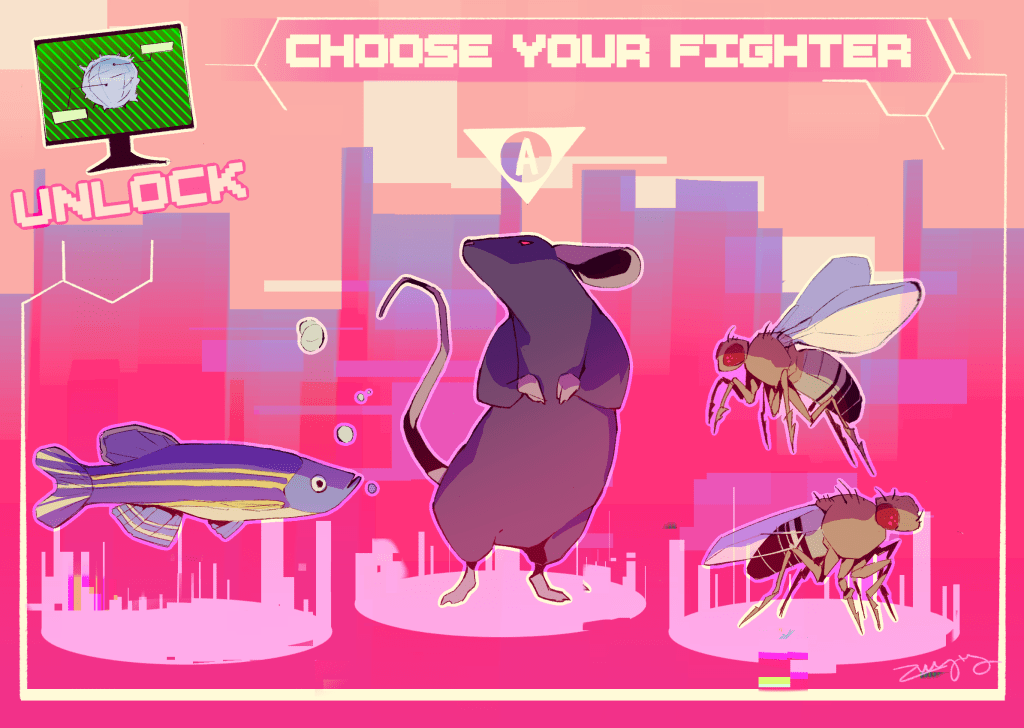
How do scientists decide which organism to study? Why use mice for some experiments, but yeast, zebrafish, or fruit flies for others? These are questions I am frequently asked by students and aspiring researchers.
In my opinion, and likely the opinion of many researchers, scientists should use the simplest model organism capable of effectively answering the biological question being investigated. Different organisms offer different advantages, and no single model system is ideal for every experiment.
~
There are far more model organisms used in research than those discussed here, but they can generally be divided into two broad categories: vertebrates and invertebrates. Invertebrate systems are often less expensive, easier to maintain, and subject to fewer regulatory requirements. Because of this, they are extremely valuable for answering molecular, genetic, and developmental questions.
It is also important to recognize that much of model organism research is ultimately aimed at understanding human biology and disease, although many researchers also study these organisms to better understand ecology, evolution, and the natural world itself. This article focuses primarily on the biomedical perspective.
If your research question centers on molecular pathways or genetics, systems such as yeast, bacteria, or cultured cells may be sufficient. Questions involving rapid development or inheritance patterns often benefit from organisms with short reproductive cycles, such as zebrafish or fruit flies. Researchers interested in regeneration may turn to organisms like sea stars or salamanders. More complex physiological or behavioral questions, however, often require mammalian systems.
~
In neuroscience research, mice are among the most commonly used model organisms because they provide a balance between biological complexity and experimental control. Their nervous systems share many organizational similarities with humans, researchers can generate highly specific genetic strains, and an enormous toolbox of experimental techniques has been developed for studying mouse brains.
At the same time, mice are still far simpler than humans. Mouse brains contain roughly 80 million neurons, while human brains contain approximately 80 billion. Although mice are incredibly valuable for studying neural circuits, disease mechanisms, and behavior, they lack many of the higher-order cognitive functions that define human thought and social behavior.
For research questions that require more advanced cognitive systems, non-human primates may provide more appropriate models. However, because of the significant ethical, financial, and logistical challenges associated with primate research, their use is far more limited and carefully regulated.
~
Human research itself also plays a massive role in modern science, though it is naturally constrained by ethical limitations. Most human studies are non-invasive and must account for tremendous biological and environmental variability between individuals. In contrast, controlled breeding in animal models allows researchers to minimize many of these variables and isolate specific biological effects more effectively.
Human studies remain essential for clinical trials, cognitive and behavioral testing, neuroimaging, electrophysiology, and countless other areas of medicine and psychology. Ultimately, progress in biomedical science depends on integrating insights from both model organisms and human research, with each approach addressing questions the other cannot fully answer alone.
Virtual Cell
ln the age of artificial intelligence and advanced computational biology, researchers are beginning to imagine entirely new ways of studying life. We now have the ability to build increasingly sophisticated computational models that can simulate biological systems and accelerate the discovery phase of research. Concepts such as the “virtual cell” aim to recreate cellular behavior digitally, allowing scientists to test hypotheses, predict molecular interactions, and identify potential drug targets before entering the laboratory.
While these approaches are incredibly promising, biology remains extraordinarily complex. Even the most advanced machine learning models still require validation in living systems. A computational prediction is only meaningful if it reflects what actually happens in real organisms.
One of the greatest limitations in biomedical research is the inability to perform invasive experimentation on the living human brain. To bridge this gap, scientists have begun developing organoids, which are miniature, simplified lab-grown tissues that mimic certain properties of real organs. Researchers at institutions such as the University of Pittsburgh have developed human brain organoids composed of neurons, astrocytes, microglia, and vascular-like structures, creating systems that can model aspects of human brain development and disease in unprecedented ways.
~
Model organisms have shaped nearly every major breakthrough in modern biology, from the foundations of genetics to our understanding of neuroscience, immunity, development, and disease. Though no experimental system is perfect, each organism offers a unique window into the complexity of life. As technology advances, the future of research will likely combine traditional model organisms with computational modeling, organoids, and artificial intelligence-driven approaches. Regardless of how advanced our tools become, the central goal remains the same: to better understand the biological systems that govern life and to use that knowledge to improve human health and our understanding of the natural world.


Leave a Reply