Anxiety and Stress in Human Evolution
Meredith Bennett, M.S.
July 2026
(5 Minutes)
Exhausting amounts of work, financial pressures, and expectations to publish. Most of our readers will be familiar with these perpetual stressors of graduate school. But regardless of your career, you are likely to experience stress fairly often. The question is, when does stress become anxiety? Does anxiety serve a purpose in the evolution of our species? Finally, how is human anxiety shaped by a rapidly changing world?
Before we address these philosophical questions, we should get a handle on what anxiety actually is. This is harder than it sounds. The line between stress and anxiety is a blurry one. The American Psychological Association delineates the two, stating that stress is usually induced by an “external trigger,” while anxiety is “defined by persistent, excessive worries that don’t go away even in the absence of a stressor” (Alvord & Halfond, 2022). While they may have different causes, however, stress and anxiety physically manifest in similar ways (Alvord & Halfond, 2022). Symptoms of both include irritability, insomnia, muscle tension/pain, and fatigue (Alvord & Halfond, 2022). These symptoms are natural consequences of the stress cycle, which is regulated by the autonomic nervous system.
The autonomic nervous system, which powers subconscious bodily functions like digestion and circulation, is composed of two parts: the sympathetic and the parasympathetic nervous systems (Mulhall, 2025). The sympathetic nervous system kicks in when you are stressed or nervous and stimulates the production of three key substances: epinephrine, norepinephrine, and cortisol (Mulhall, 2025). Epinephrine causes your heart to race and your muscles to tense, norepinephrine raises blood pressure, and cortisol provides energy by creating glucose (Mulhall, 2025). The parasympathetic nervous system is the inverse of the sympathetic nervous system, helping you relax and get back to normal after a stressful time (Mulhall, 2025). These relaxing effects are primarily driven by the release of acetylcholine and stimulation of the Vagus nerve (Mulhall, 2025). Acetylcholine slows your heart rate and relaxes muscle tension, while the Vagus nerve fights inflammation and reduces cortisol levels (Mulhall, 2025). Now that we understand the physical manifestations of stress and anxiety, let’s dive into why they evolved in the first place.
First, take a moment to think about why you do the things you do. Maybe you incorporate more vegetables in your dinner, because you want to be healthier. Or you devote time to working on a manuscript, because publication will draw attention to your work and help you get a job post-graduation. In both cases, you are working towards a long-term goal. Believe it or not, this type of decision-making is relatively new in human evolution. Ancient humans, like other modern animals, lived in an immediate-return environment, meaning your actions have obvious and immediate consequences on your life (Clear, 2016). For example, responding to the presence of a predator by running away is a decision that direction influences the likelihood of your continued existence. Unlike ancient humans, however, modern humans generally live in delayed-return environments (Clear, 2016). This means the decisions we make on a daily basis typically don’t have immediate consequences. Unfortunately, you don’t immediately land in your dream job by working on some edits for a manuscript.
So, did early humans experience anxiety? Again, it depends on how you define anxiety. They certainly felt stress and temporary anxiousness but probably did not experience chronic anxiety. Being anxious sometimes likely contributed to their evolution (Clear, 2016). Behavioral scientists have suggested that heightened anxiety in early humans may have led to increasingly cooperative behavior, which increased the fitness of our species (Veit & Browning, 2023). For example, anxiety about a predator near your home might prompt quick action to gather all of your friends and family inside. This removes everyone from harm’s way but also strengthens your social bonds, because you know the community will look after one another. Based on these theories of anxiety-led evolution, however, there should be a point where increases in anxiousness are no longer advantageous and become counterproductive (Veit & Browning, 2023). Furthermore, most modern humans no longer deal with the same threats faced by early hominins. Because the development of modern society has substantially outpaced the evolutionary development of our brains, our neural hardware is simply not well-equipped to deal with chronic modern stressors.
The pace of societal development is not likely to slow down. How can we deal with the chronic anxiety that often comes with the modern world? Typical recommendations include exercise, including yoga, and mindfulness (Mulhall, 2025). Many of these activities help by stimulating the vagus nerve, which promotes relaxation (Mulhall, 2025). Another way to boost the parasympathetic nervous system is by engaging in social connection (Mulhall, 2025). As a social species, humans crave a sense of belonging and need social connection to feel safe. Like yoga and mindfulness, positive social interaction stimulates the vagus nerve (Mulhall, 2025). All of these activities can help complete the stress cycle in your body. So, the next time you’re losing sleep over the state of your dissertation, remember that you inhabit a body designed to deal with the threat of prowling lions, not academic crises. And while you’re at it, reach out to a friend! They’re probably feeling anxious too.
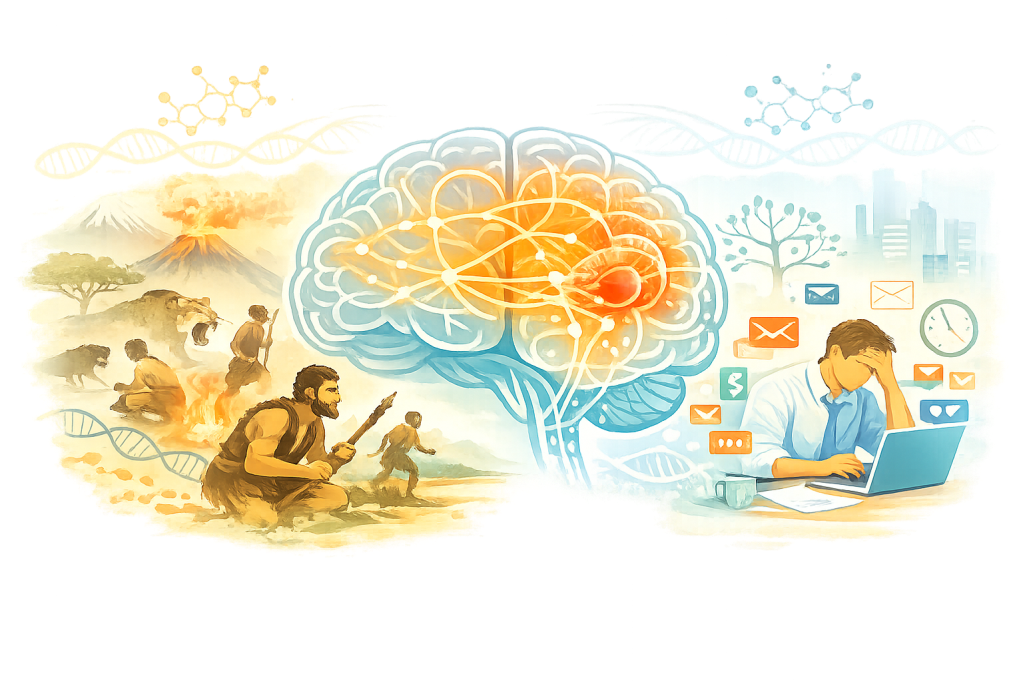
(Generated with AI)
References:
Alvord, M., & Halfond, R. (2022, February 14). What’s the difference between stress and anxiety? American Psychological Association. https://Www.Apa.Org. https://www.apa.org/topics/stress/anxiety-difference
Clear, J. (2016, March 22). The Evolution of Anxiety: Why We Worry and What to Do About It. James Clear. https://jamesclear.com/evolution-of-anxiety
Mulhall, M. (2025, June 16). Understanding Anxiety: Evolution, Biology, and Action. Oakland Psychological Clinic of Michigan. https://www.oakpsych.com/2025/06/16/understanding-anxiety-evolution-biology-and-action/
Veit, W., & Browning, H. (2023). Hominin life history, pathological complexity, and the evolution of anxiety. Behavioral and Brain Sciences, 46, e79. https://doi.org/10.1017/S0140525X22001923
 Grads Gone Rogue
Leave a comment