Sarah Boothman, Ph.D.
September 2026
(8 Minutes)
This article contains spoilers for both the book and film adaptation. Read at your own risk!
Last month, I was on a plane, and I pulled out my copy of Project Hail Mary by Andy Weir to keep me occupied. The woman to the right of me recognized the cover and said, “That book is so good! One of my top reads of the year!” Not too long after this, I noticed the man sitting to the left of me was watching the film adaptation on his laptop. I glanced ahead of me and noticed that another person was also watching the film on their phone. This piece of science fiction has permeated our cultural zeitgeist, and after finishing the book, I could definitely see why. It is a captivating tale full of emotion, innovation, and humor.
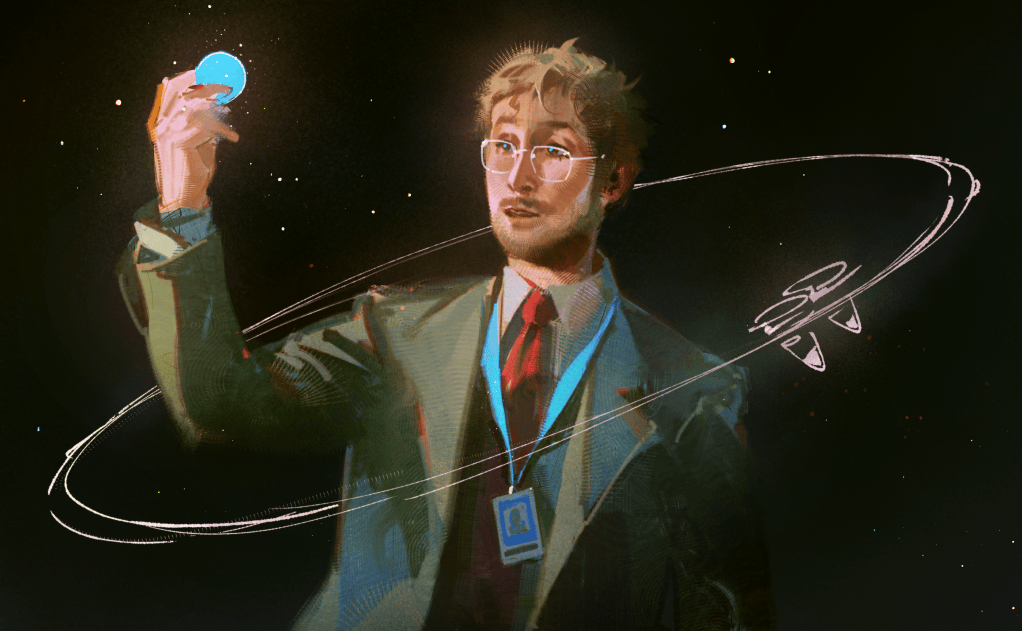
The story follows Dr. Ryland Grace, a failed academic turned middle school science teacher, as he ventures to another solar system to find a cure for Astrophage, a space-dwelling microbe that is eating our sun. While there, he teams up with a loveable alien, Rocky, who is also searching for a way to defeat Astrophage, and the two of them end up saving the day. The premise relies heavily on astronomy, biology, engineering, and physics, but Andy Weir is able to communicate these subject matters in a beautifully accessible way. As the son of a particle physicist and an electrical engineer, Weir was “doomed to be a nerd from the start” and spent a lot of his career blending his technical skills and creative mind. The result is a collection of science fiction novels that expertly weave science communication into the fabric of each story. A brilliant example of this is Grace’s role as a middle school teacher in Project Hail Mary. This enables Grace’s character to simplify complex scientific concepts and make them accessible to his colleagues, Rocky, and the readers without it seeming too expository.
On the topic of Grace, it is no surprise that I (a scientist) fell in love with him after only a few chapters. Not only is he quirky, smart, and loveable, but he is also an accurate representation of a modern scientist. Throughout the entire story, he never feels like he’s the right person to be leading the project, even though he consistently shows up and knocks it out of the park. This feeling of imposter syndrome is all too common in research, especially in academia. The goal post is always moving, and we feel like we will never be good enough to reach it, even if we have prior experiences that show otherwise. Grace has a lot of these experiences to back him up – he goes through multiple failures and redirections throughout the story just like any good scientist would. Failing is a normal and important part of the scientific process. When things don’t work the way that we expect, we learn something new. When our hypotheses are proven wrong, we are forced to gain new perspectives to come up with different ones. Each failure gives us more information about the system we’re working in. A good scientist learns how to work with failure and redirect the research in a productive way, and I think Weir does a great job embodying this idea in Grace’s character and journey. While reading this book, I fell a little bit more in love with the thrill of scientific discovery while joining Grace and Rocky on all these ups and downs.
Alongside this depiction of the scientific process, Weir explores a theme of sacrifice. In the book, a team of men and women lay down their lives to make this journey and save the planet. They are revered by everyone around them, and they earn a lot of respect. Literally sacrificing one’s life is (thankfully) not commonplace for scientists in our culture, but we do make sacrifices for our work. It takes years to get a PhD, and during those years (which should be the “best years of our lives”), we work constantly while getting paid miniscule amounts. We put off big life events like buying homes, getting married, and having children. Some of us go into debt. Our relationships with family and friends can be strained. Our mental health definitely takes a hit. All for the sake of adding three letters to the end of our names. All for publishing papers that maybe 200 people will read. All for contributing one little nugget of information to humanity’s collective knowledge bank. No wonder these people were willing to give up their lives to save the Earth. We’ve given up so much for a lot less.
Ultimately, this is a science fiction novel, so there are a lot of aspects of Grace’s situation that are more ‘fi’ than ‘sci’. The most obvious one to me is that his research is supported by a ton of money and resources. Everything he needs is available to him, which is not the reality for many researchers. We use decades-old equipment and budget out our reagents in order to do what we need to do. We have to write long grants, begging for money to be able to afford even a single experiment. At the core of this issue are public and government opinions of science. In the story, world leaders and the general public are very trusting of science. Researchers tell them that the world is in trouble, and they respond by funding a project to fix it. But would this be true in our current world? If there were an extinction-level event threatening Earth right now, would we respond in the same way? Would we trust scientists to fix it? Would people even believe that it was happening? The response to climate change, COVID-19, and vaccines do not set a good precedent. I imagine it would be a lot more like the movie, “Don’t Look Up,” where a meteor is hurdling towards Earth and no one believes it until influencers and celebrities start posting about it. This is a sobering thought, but it should remind all of us how important science communication and education really are.
Speaking of the general public, I would be remiss if I didn’t discuss the film adaptation, the form of this story people will most likely interact with. I have a sticker on my laptop that states, “don’t judge a book by its movie,” so feel free to take my opinions here with a grain of salt. First off, I thought the movie was visually stunning and it had a great score/soundtrack. I really enjoyed how they depicted Rocky, as he was hard for me to visualize while reading the book. However, from the science angle, I feel that the movie missed the mark. I understand that they have to make cuts to make the content accessible (and to ensure that the film is not 5 hours long), but I felt like the movie did not have the same level of scientific rigor and attention to detail that the book did. The prime example of this was Grace using a blatantly unbalanced centrifuge in the lab, which threw many researchers into a tizzy on social media after the movie’s release. By removing a lot of the “technical stuff,” we also missed a lot of the emotion of scientific discovery that I felt while reading the book. We didn’t see the failures or the process of having to brainstorm every step of the way. The resolutions just seemed too easy, and real science does not work like that. I also did not appreciate some of the changes they made to Dr. Grace’s character. In the book, he is a wicked smart man who is dedicated and assertive. In the movie, he seems kind of dopey and mellow. I can understand adjusting his character a little bit because no one would ever be that smart and look like Ryan Gosling, but in making him more relatable, it took away a lot of traits that I connected with as a scientist. It’s a tricky situation, because we want to convey the truth that scientists are normal people, but the story also needs the strong and smart man that Dr. Grace was in the books, and the film adaptation simply did not strike the right balance.
Overall, I give the book five stars. It is a triumphant piece of storytelling mixed with great science communication. Similar to the woman I sat next to on the plane, I recommended it to all the readers I know after I finished it. However, I have to knock the movie down to three and a half stars. It is cinematically beautiful and does an excellent job pulling at your emotions, but the adaptation lacks Andy Weir’s nerdy wonder and ultimately does science a disservice.


Leave a Reply