
Alex Cope, Ph.D.
October 2026
(6 Minutes)
Our bodies are a series of complex, often interwoven, systems. Consider even the seemingly simple act of breathing, which requires multiple organs to perform specific jobs. Each of these organs, in turn, consists of collections of cells, called tissues. These cells may have different functional roles within these tissues. Each cell contains multiple proteins and metabolites that shape its function. Quite a few things need to go right in our bodies for us to take a single breath!
Such interconnected systems seem hardly capable of change: alter one part, and the whole thing could break. However, a system’s final product is often what matters for an organism’s ability to live and reproduce. As long as a system produces the more-or-less correct output, the individual parts of the system do not necessarily matter. This potentially allows for a surprising amount of evolution of the individual parts without changing the output of the system.
True and Haag proposed the theory of “system drift” to explain how the parts of a system can evolve (True & Haag, 2001). Originally proposed in the context of embryo development, the concept has been extended to inform our understanding of systems such as gene regulation (Jiang et al., 2023) and even the emergence of new species (Schiffman & Ralph, 2022).
Studies on the role of system drift in evolution have been disparate because scientists lacked a general method for studying system drift. Earlier this year, Dr. Carl Veller and Dr. Pavitra Muralidhar at the University of Chicago published a paper in the Proceedings of the National Academy of Sciences (PNAS) to address this missing piece (Veller & Muralidhar, 2026). Veller and Muralidhar framed system drift in the context of population genetics, which is the study of how and why DNA varies (i.e., genetic variation) across members of a population.
Veller and Muralidhar’s model goes something like this. First, assume “standing genetic variation,” which simply means there are genetic variants within the population. Next, imagine a system made up of N parts, and the system’s output is the sum of these N parts. As an example in their paper, Veller and Muralidhar say these N parts could be something as simple as non-overlapping regions of DNA, such as different chromosomes. Each part of the system contributes some amount to the overall output of the system, which is some trait of interest. In their model, the system is literally the sum of its parts. Now, because of standing genetic variation, many of the individual parts will contribute to the overall genetic variation of the system output. Importantly, some parts of the system contribute substantially to the system output’s genetic variation, while others make much smaller contributions.
The system output is assumed to evolve under stabilizing selection. Stabilizing selection disfavors “extreme” values of a trait, tending to keep individuals close to the “optimum” value of the trait. The stronger the stabilizing selection, the closer individuals are to this optimum value. As a result, individuals tend to be distributed around this optimum, which often ends up being pretty close to the average value of the trait. For example, human height is thought to be shaped by stabilizing selection: after controlling for sex differences, most (95%) of adults fall within about 30 cm (or 12 in) of each other. In the grand scheme of things, that’s not a huge height difference. Put another way, stabilizing selection reduces the variance, or the spread, of the values.
Different modes of evolution are expected to lead to unique patterns in the evolution of a trait. Consider what would happen if we were to replay the tape of life. While we can’t really do this, we can use math to get a sense of what we could expect under system drift. If we were to replay the evolution of a population many times, then we can compare how much the trait and individual parts vary at each time point across the populations. Across populations, the variance in the trait evolving under stabilizing selection plateaus (Figure 1, blue line). This is because in each of the populations, stabilizing selection disfavors trait values too far from the optimum. In contrast, a neutrally evolving trait (i.e., without natural selection) will see the variance across the populations increase linearly with time (Figure 1, green line).
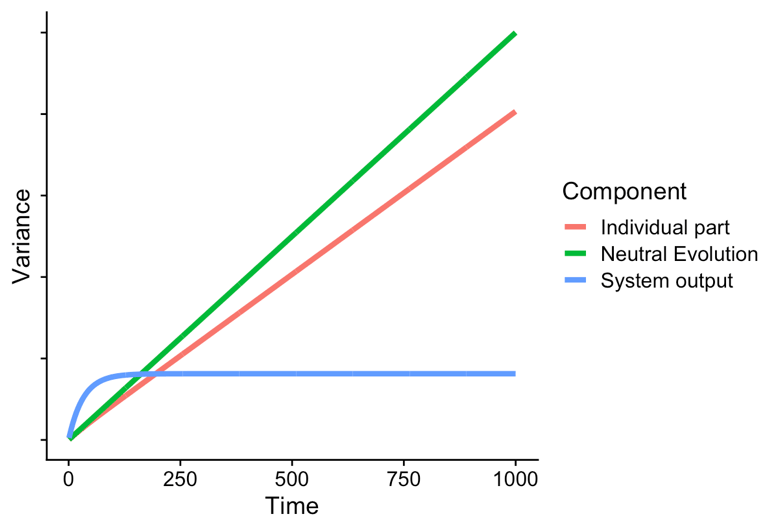
The main conclusion of Veller and Muralidhar was that even though the output of a system evolves like a trait under stabilizing selection, the individual parts behave almost like they are evolving without natural selection (Figure 1, red line). Notice I said “almost.” This is because the increase in variance with time is slower than true neutral evolution. How much is reduced? It depends on how much genetic variation the individual part contributes to the system output: the more it contributes, the slower the increase in variance. Regardless, the primary takeaway is that even if a trait stays roughly the same over evolutionary time, the parts that build it can change substantially.
Veller and Muralidhar used both mathematical proofs and simulations to understand how various traits and genetic systems might evolve under system drift. But how important is system drift in real populations? To quote Christopher Nolan’s Oppenheimer, “theory will only take you so far.” Thanks to the increased availability of genetic and trait-level data in multiple species and populations, scientists are in an excellent position to test system drift as a hypothesis.
Bibliography
Jiang, D., Cope, A. L., Zhang, J., & Pennell, M. (2023). On the Decoupling of Evolutionary Changes in mRNA and Protein Levels. Molecular Biology and Evolution, 40(8), msad169. https://doi.org/10.1093/molbev/msad169
Schiffman, J. S., & Ralph, P. L. (2022). System drift and speciation. Evolution, 76(2), 236–251. https://doi.org/10.1111/EVO.14356
True, J. R., & Haag, E. S. (2001). Developmental system drift and flexibility in evolutionary trajectories. Evolution and Development, 3(2), 109–119. https://doi.org/10.1046/j.1525-142X.2001.003002109.x
Veller, C., & Muralidhar, P. (2026). Quantitative system drift. Proceedings of the National Academy of Sciences of the United States of America, 123(12), e2527137123. https://doi.org/10.1073/PNAS.2527137123


Leave a Reply