
Anonymous
November 2026
(5 Minutes)
The tree in my backyard knows what time it is.
Well-known for its crisp air, gourds, and spiced lattes, Autumn may be most recognized for the colorful blaze that sets forests and neighborhoods alight every year. But what is the reason for the sudden change to these pyric hues between September and November, particularly in the north-eastern United States? A couple of friends of mine were walking with me through the Upper Peninsula in Michigan and we were completely inspired by the vibrant colors and pondered the question. We thought maybe it was the cold weather trees were responding to. We thought, maybe because the trees are losing their leaves in the cold winter, and the fall colors were preceding the dropping of the leaves; then therefore the trees were detecting a change in temperature. However, because the temperature can be so variable throughout the year, deciduous trees need a more stable account of the change of the seasons. Another way of phrasing the question; How do trees know what time of year it is?
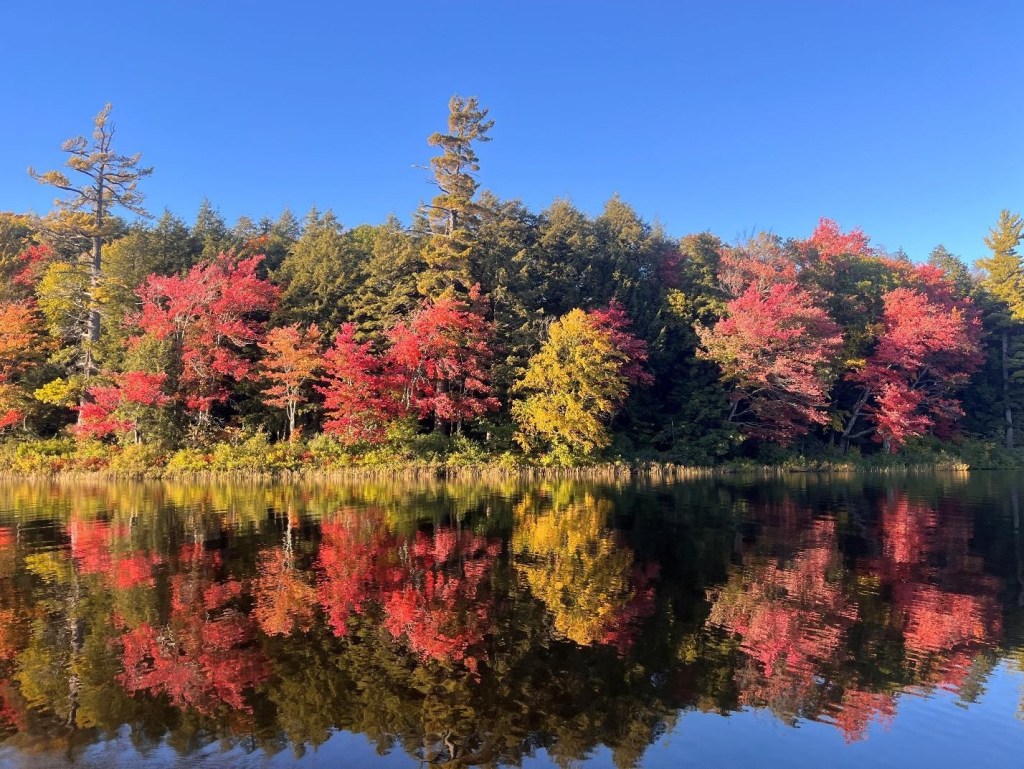
Long before animals were detecting light using photoreceptors in their eyes, trees were detecting light with molecules in their leaves called chlorophyll. The less whimsical among you will point out that trees do not have eyes and are not ‘detecting’ light per se, but rather capturing energy from light to initiate anabolic metabolism pathways to construct sugars. Indeed, this is true, however plants appear to internalize circadian rhythms through sensing the production of sugars. When sugar production is high, presumably it is daytime. When sugar production is low, perhaps it is night, right? Who needs a brain after all? It turns out, trees are capable of regulating sap flow through the trunk as well as the opening of their stomata (openings in the leaf for respiration) before dawn in anticipation of the sunrise. As trees begin to detect that the benefit they gain from metabolizing sugars is diminishing with the shortening day compared to the energy it takes to maintain the health of the leaves, trees undergo a process called abscission – the cutting of resources to the leaf. Here, the arboreal conflagration begins.
One could expect then that the trees further north where daytime becomes shorter, earlier in the year, abscission would begin earlier and indeed this is what occurs. Anecdotally, upon returning to Pittsburgh, south of the Upper Peninsula where the fall colors were in full swing, we found that we were surrounded by lush green again. A couple of weeks later, fall crept in and I wondered where the fall colors came from. It turns out that many of the molecules that control the yellows and oranges we see are derived from molecules already in the leaf. Normally, the chlorophyl dominates the spectrum of colors emitted from the leaf but during abscission, when the leaf is cut off from the body of the tree, the chlorophyl reserves are not maintained and are recycled. What is left are carotenoids, the stabilizing molecules for chlorophyl that reflect yellow and orange. Embedded in its namesake, carotenoids are commonly found in carrots and a responsible for their uncommon orange color. The deep reds and purples found in maple trees arise from a different process during abscission. Once the leaf is beginning to be functionally severed from the tree, trapped sugars induce the production of a class of molecules called anthocyanins. These are the molecules in some fruits like blueberries and are famed for their antioxidant capability, and yet, here they are in leaves!
A question that had bugged me when I learned this was: Why go through the trouble of making anthocyanins in the first place? After all, the leaf is about to fall off the tree. Why invest resources in producing new molecules when the leaf is approaching the end of its life? One hypothesis is that anthocyanins act as a kind of sunscreen, protecting the leaf’s photosynthetic machinery from excessive light while the tree recovers final valuable nutrients before winter. The precise evolutionary advantages of autumn coloration remain an active area of research, and the benefits may differ between species.
There is something rather remarkable about this process. A tree cannot look at a calendar, check the weather forecast, or notice that its neighbors have begun to change color. Instead, it integrates information from its environment. These signals influence a cascade of molecular events that ultimately determines when the tree begins to withdraw resources, dismantle its photosynthetic machinery, and prepare for winter.
Which brings us back to our original question: How do trees know what time of year it is?
Perhaps the more interesting question is what we mean when we say that something knows anything at all. A tree does not need a brain to distinguish between summer and autumn, any more than it needs eyes to respond to sunlight. It uses its knowledge of the time of day to make predictions about when to prepare for sunrise. Its cells have evolved mechanisms for sensing environmental conditions, integrating signals, and coordinating behavior across an organism that may rise a hundred feet. The result appears to me like biological anticipation operating on much longer time scales than humans are accustomed to.
Walking through the Upper Peninsula, we had initially assumed that the cold was telling the trees that winter was coming. Yet, the trees had been reading the signs of autumn long before we noticed them ourselves. The shortening days had initiated a series of events that would transform green forests into a brilliant mosaic of yellow, orange, red, and purple specific to innately accessible biological machinery.


Leave a Reply